

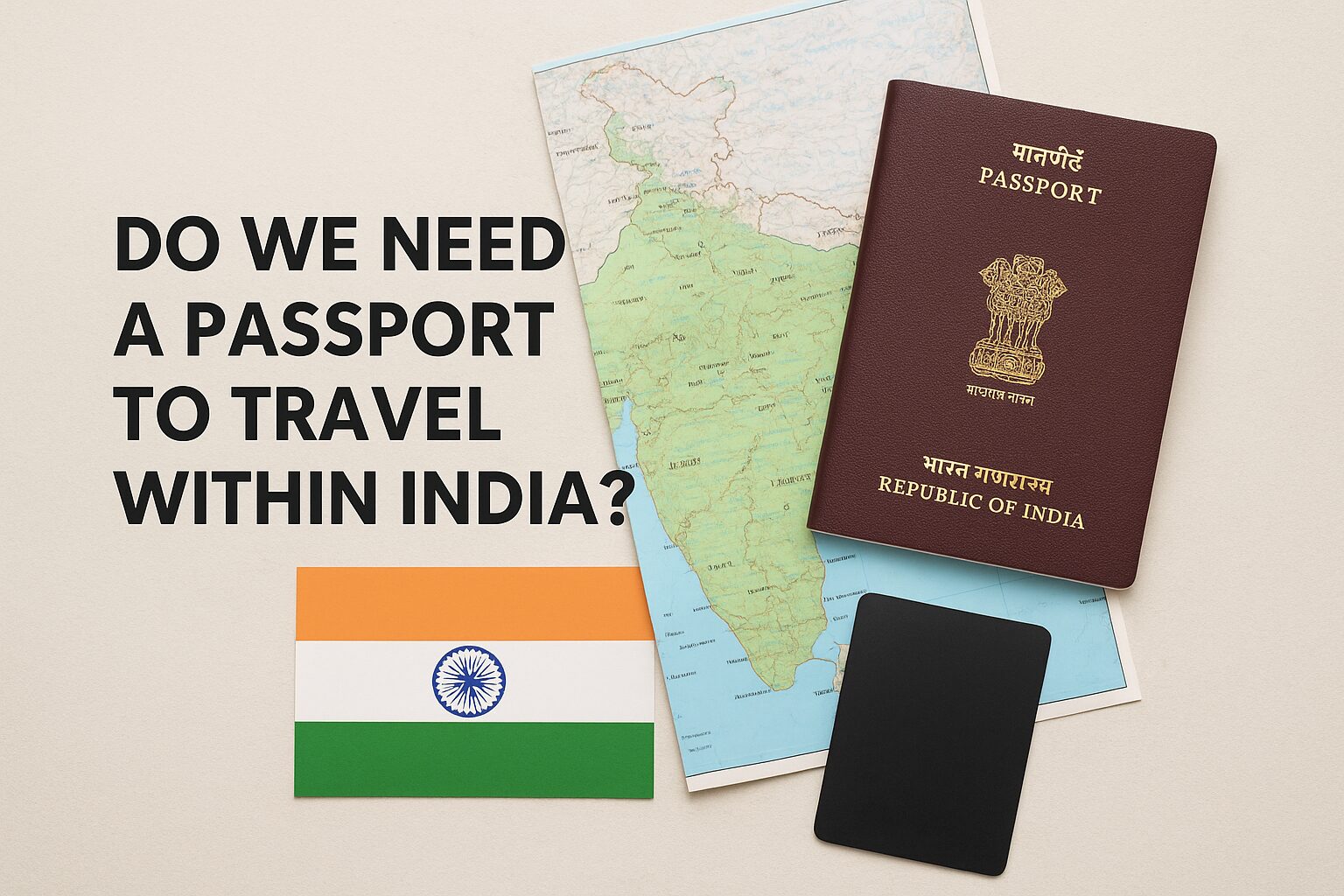

Domestic travel in India is common and generally uncomplicated, but many travellers—especially first-time flyers—often ask whether a passport is necessary for internal movement. India has clear documentation rules for flights, trains, buses, hotels, and regulated regions. This article outlines these requirements in a structured, factual format so travellers can prepare the correct documents before starting their journey.
Is a Passport Required for Domestic Travel in India?
For Indian citizens: No.
A passport is not required to travel anywhere within India. However, a valid government-issued photo ID is mandatory for flights, most reserved train classes, and hotel check-ins.
For foreign visitors: Yes.
Foreign nationals must carry their passport and a valid Indian visa for all domestic travel. These documents are also mandatory for hotel stays and may be checked at certain protected or restricted areas.
Valid Travel Documents for Indian Citizens
The documents needed differ by transport mode. The sections below explain what is required for flights, trains, buses, and accommodation.
For Domestic Flights
Airports in India operate under DGCA regulations. All passengers must show a valid photo ID at:
- Airport entry
- Check-in counters
- Security screening
- Boarding gates
Accepted ID proofs include:
- Aadhaar Card
- Voter ID
- Passport
- Driving Licence
- PAN Card
- Service ID (Government employees)
- Student ID (with limitations)
- Documents stored in DigiLocker (when accepted by staff)
Without a valid ID, boarding may be denied.
For Train Travel (AC/Sleeper/General)
Indian Railways requires ID mainly for reserved compartments.
- AC, Sleeper, Chair Car: At least one passenger must carry an original ID.
- General/Unreserved: ID is not mandatory but recommended.
- Tatkal: ID details are required at booking and should match the ID carried during travel.
Accepted IDs include Aadhaar, Driving Licence, Passport, Voter ID, and PAN Card.
For Bus & Road Travel
Documentation rules vary based on the operator:
- State transport buses: Usually do not require ID for regular or non-reserved services.
- AC or reserved buses: ID may be checked before boarding.
- Private long-distance buses: ID is often required during check-in.
Carrying an ID is advisable even when not officially mandatory.
For Hotel Check-in
Hotels and accommodation providers in India must verify guest identity as per local police rules.
Accepted IDs for Indian citizens:
- Aadhaar Card
- Passport
- Driving Licence
- Voter ID
- PAN Card (may not be accepted everywhere because it lacks an address)
No hotel can legally check in a guest without proper ID.
List of Accepted Government ID Proofs in India
Most domestic transport and hotels accept the following ID proofs:
- Aadhaar Card
- Passport
- Driving Licence
- Voter ID
- PAN Card
- Government Service ID
- NPR Smart Card
- Student ID (limited use)
- DigiLocker digital versions of government IDs
Indian citizens are not required to carry Aadhaar specifically, as long as another valid ID proof is available.
Passport vs Aadhaar vs Driving Licence (Comparison Table)
| Document | Required for Domestic Travel? | Accepted at Airports? | Accepted for Trains? | Accepted for Hotels? | Notes |
|---|---|---|---|---|---|
| Passport | No (Indians) / Yes (Foreigners) | Yes | Yes | Yes | Essential for foreign visitors |
| Aadhaar Card | No | Yes | Yes | Yes | Most widely used ID |
| Driving Licence | No | Yes | Yes | Yes | Strong photo ID |
| Voter ID | No | Yes | Yes | Yes | Common alternative |
| PAN Card | No | Yes (most airports) | Yes | Sometimes limited | Lacks address |
| Student ID | No | Limited | Limited | Limited | Not reliable alone |
Digital Documents: Is DigiLocker Accepted?
DigiLocker is increasingly accepted, especially for:
- Aadhaar
- Driving Licence
- Vehicle registration
- Other digital government records
Most airport security points allow DigiLocker IDs, but acceptance may differ slightly by staff or location. Carrying physical copies remains safer during peak travel or at smaller airports.
What Happens If You Don’t Carry Any Valid ID?
Consequences depend on the type of travel:
- Flights: Entry may be refused. Some airports permit an alternative verification process by CISF, but it is not guaranteed.
- Trains (reserved classes): Passengers may be penalized or treated as without a valid ticket.
- Buses: You may still travel on non-reserved services, but private operators may deny boarding.
- Hotels: Check-in is not permitted under any circumstance.
ID is always required for foreign nationals, regardless of travel mode.
Special Cases: Children, Students, and Foreign Nationals
Children (Indian Citizens)
- Infants and small children may travel without standard government IDs.
- For flights, proof of age (birth certificate or school ID) may be required.
- For hotels, minors must check in with parents/guardians who present valid ID.
Students
- Student IDs may only be accepted for specific situations such as railway concessions.
- They are not reliable for flights or hotel check-ins.
Foreign Nationals
Foreign travellers must carry:
- Passport
- Valid Indian visa (e-visa, tourist visa, business visa, etc.)
These are required at:
- Domestic airports
- Railway booking counters (in some cases)
- Hotel check-ins
- Restricted or protected area entrances
Foreign nationals are also monitored under FRRO requirements, and hotels must record passport/visa details during check-in. Some protected regions require special permits for foreigners, which must be carried during travel.
State-wise or UT-specific Document Rules
Most states follow uniform national identification rules. However, some regions have additional requirements:
- Arunachal Pradesh, Nagaland, Mizoram: Inner Line Permit (ILP) needed for both Indian and foreign visitors.
- Ladakh and certain Himalayan border regions: Protected Area Permits (PAP) required for foreign nationals.
- Andaman & Nicobar Islands: Restricted Area Permits apply to foreign visitors entering specific zones.
These permits are in addition to standard ID requirements and must be carried during the journey.
Important Rules You Should Know (DGCA, Railways, Hotels)
DGCA (Flights):
- A valid government-issued photo ID is mandatory.
- The name on the ticket must match the ID.
- Foreign nationals must present passport and visa.
Indian Railways:
- ID required for all reserved classes.
- ID details for Tatkal tickets must match the ID carried.
- Foreign tourists in certain trains may need passport details during booking.
Hotels:
- All guests must carry valid ID.
- Foreign visitors must provide passport, visa, and complete mandatory registration forms.
Hotels cannot legally check in guests without the required documents.
Checklist: Documents You Should Carry for Domestic Travel in India
- One valid government-issued photo ID
- Flight/train/bus ticket (printed or digital)
- Hotel booking confirmation
- DigiLocker access (if using digital ID)
- Foreign visitors: Passport + Indian visa + any required permits
FAQs
1. Do we need a passport to travel within India?
Indian citizens do not need a passport; foreign visitors do.
2. What valid ID proofs are accepted for domestic flights?
Aadhaar, Passport, Driving Licence, Voter ID, PAN Card, and DigiLocker documents.
3. Can I travel without Aadhaar card in India?
Yes. Any accepted photo ID is sufficient.
4. Is driving licence valid for domestic flight?
Yes, it is accepted at all Indian airports.
5. What ID do foreigners need for domestic travel?
Passport and valid Indian visa.
6. Do I need an ID for general class train travel?
No, but carrying an ID is recommended.
7. Are digital documents from DigiLocker accepted everywhere?
Accepted at many checkpoints but physical copies are safer.
8. Can hotels accept soft copies of ID?
Some do, but many prefer original or physical documents.
9. Do children need ID to fly domestically?
Proof of age (birth certificate or school ID) may be required.
10. Are special permits needed for certain Indian states?
Yes, for ILP and PAP areas like Arunachal Pradesh, parts of Ladakh, and the Andamans.
Final Summary
A passport is not required for domestic travel within India by Indian citizens. However, carrying a valid government-issued photo ID is essential for flights, reserved train travel, and hotel check-ins. Foreign visitors must carry a passport, a valid Indian visa, and any special permits required for specific regions. Having the correct documents ensures smooth, uninterrupted travel across India’s transport and accommodation systems.