

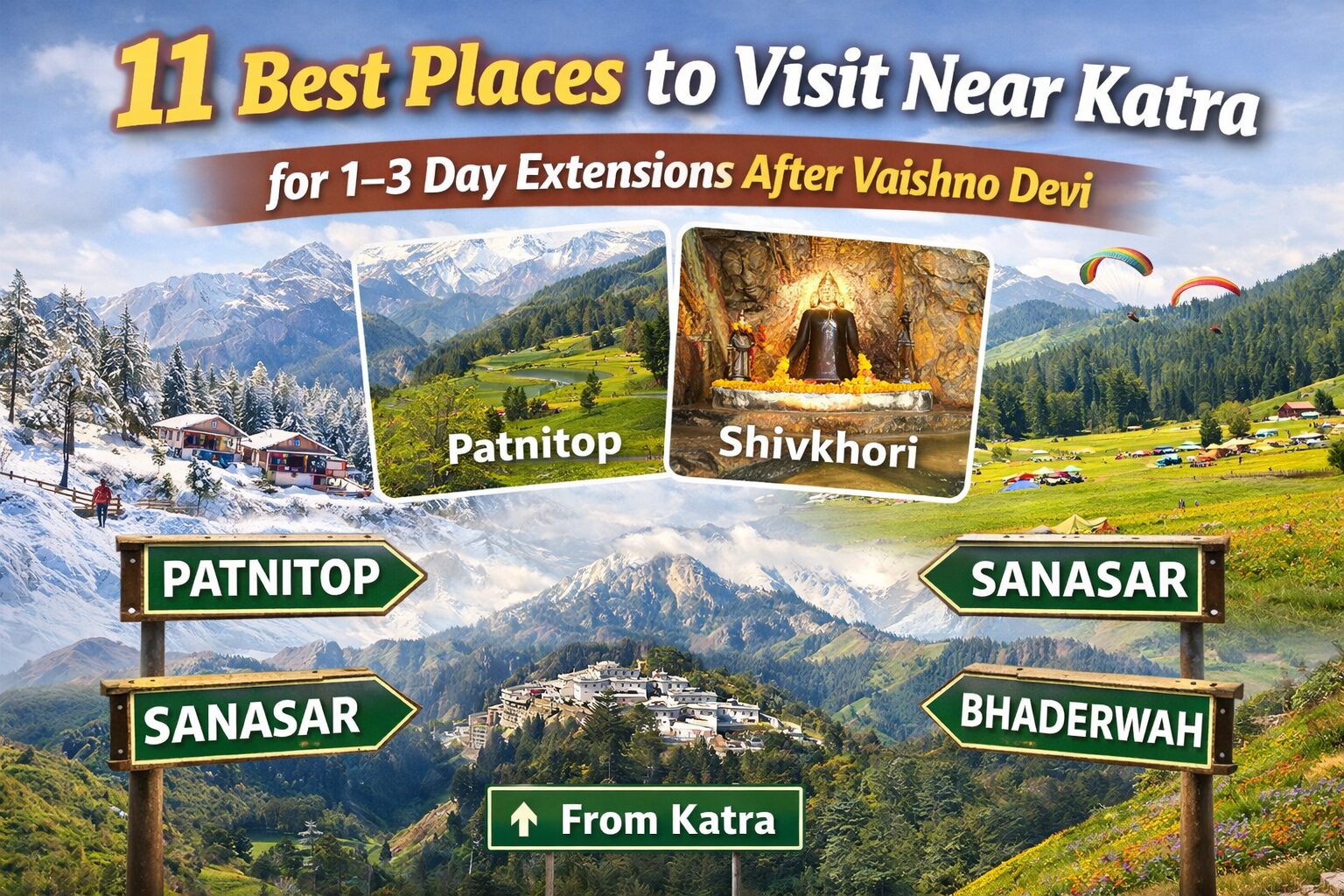

11 Best Places to Visit Near Katra for 1–3 Day Extensions After Vaishno Devi
For most travellers, Katra is synonymous with the sacred Vaishno Devi Yatra. But once the darshan is done and the adrenaline of the climb settles, many pilgrims and families realise they still have a day or two in hand – and no clear idea how to use it.
This guide is designed exactly for that moment. If you’re thinking, “We’ve come all the way to Katra, what else can we see nearby in 1–3 days?” you’ll find practical, realistic options here – from short same-day outings to slightly longer 2–3 day hill getaways.
Distances and travel times are based on typical road conditions and are meant to help you plan your energy and time after a demanding trek. Most options are family-friendly and suitable for mixed-age groups, including seniors.
Quick Overview: Nearby Places by Duration & Style
If you’ve already done the Vaishno Devi Darshan, here’s how to think about extensions from Katra:
- Half-day to 1-day trips (very light travel): Jhajjar Kotli, Baba Dhansar, Deva Mai, Katra town surroundings
- 1–2 day extensions (easy add-ons): Patnitop, Shivkhori, Jammu City
- 2–3 day hill escapes (cooler climate, relaxed pace): Patnitop + Sanasar, Sithan Top circuit, extended Jammu sightseeing
You do not have to cover everything. In fact, after a trek to Vaishno Devi, slower and fewer stops usually feel better than an over-packed schedule.
1. Patnitop – Classic Hill Station Near Katra
Distance from Katra: ~80 km
Typical drive time: 2.5–3 hours one way
Recommended duration: 1–2 nights
Patnitop is the most popular hill station people combine with Katra. At around 2,024 metres, it offers a genuine change of weather – cooler temperatures, pine forests, and open meadows that feel worlds away from the crowds of Banganga and Bhawan.
Highlights & Things to Do in Patnitop
- Leisure walks in the pines: The main appeal here is simple: fresh air, easy forest walks, and views of the Chenab valley.
- Madhatop: A quieter area a short drive or trek away, good for those looking for less commercial surroundings.
- Skyview Patnitop (Gondola & Activities): A ropeway that offers panoramic views, with optional adventure activities like zipline, tubing and more. Many families visit just for the ropeway and a meal with a view.
- Snow (in winter): From roughly late December to February (varies by year), Patnitop can receive snow, turning it into a simple, accessible snow-play destination from Katra/Jammu.
Who Patnitop Is Best For
- Families wanting one easy hill station after darshan
- Older travellers who prefer short, gentle walks
- Couples looking for a relaxed, not-too-remote getaway
Suggested plan: Leave Katra after breakfast, reach Patnitop by early afternoon, enjoy an evening stroll. Next morning, do the ropeway and a leisurely walk, then head back towards Jammu or onward to your next destination.
2. Sanasar – Meadows, Quiet & Soft Adventure
Distance from Katra: ~110–120 km (via Patnitop)
Typical drive time: 3.5–4 hours one way from Katra
Recommended duration: Day trip from Patnitop or 1 night
Sanasar is often clubbed with Patnitop but feels noticeably more open and rural. Think wide meadows, views of surrounding hills and a much calmer atmosphere than touristy hubs.
Highlights & Things to Do in Sanasar
- Sanasar meadow: A large green expanse ideal for picnics, light walks, and relaxed family time.
- Paragliding (seasonal): When operational and weather permitting, Sanasar hosts paragliding activities operated by local agencies.
- Boating (seasonal / local pond): Basic paddle or row boating may be available, more for the simple experience than for scenery.
- Photography: Good landscapes and sky views, especially around sunrise or later afternoon.
Suggested plan: Stay in Patnitop and do Sanasar as a day trip, or spend one night in or near Sanasar if you value quiet over choice of facilities.
3. Shivkhori – Sacred Cave Shrine of Lord Shiva
Distance from Katra: ~80–90 km (via Reasi)
Typical drive time: 3–3.5 hours one way
Recommended duration: 1 long day or 1 night
Shivkhori is one of the most significant spiritual excursions from Katra. The main attraction is a naturally formed cave dedicated to Lord Shiva, believed to house a self-manifested (swayambhu) lingam. Many pilgrims consider it a powerful complement to the Vaishno Devi Yatra.
Highlights & Experience at Shivkhori
- Cave walk: The cave passage is narrow in parts, with low ceilings and wet surfaces. Handrails are available but expect some bending and careful walking.
- Sacred atmosphere: Devotional chants, offerings and a strong spiritual environment similar in intensity to major shrines, but typically less crowded than Vaishno Devi.
- Scenic drive: The road towards Reasi and Shivkhori passes through rural landscapes and hills, giving a different perspective than the Katra–Jammu highway.
Who Shivkhori Is Best For
- Devotees wanting to extend their spiritual journey
- Travellers comfortable with basic facilities and slightly longer drives
Note: The cave can be challenging for those with mobility issues, severe claustrophobia or breathing difficulties. If travelling with elderly family members, discuss the physical demands clearly before planning.
4. Baba Dhansar – Scenic Temple & Natural Springs
Distance from Katra: ~15–18 km
Typical drive time: 30–40 minutes one way
Recommended duration: Half-day
Baba Dhansar is one of the easiest and most satisfying short outings from Katra. It combines a scenic temple complex with natural springs and a small waterfall set against limestone rocks and greenery.
What to Expect at Baba Dhansar
- Temple of Baba Dhansar & Shiva: A revered local shrine with strong regional faith attached to it.
- Waterfall & pools: A photogenic setting where crystal-clear water emerges from the rocks and forms small pools (bathing may be restricted in some areas – follow local signage).
- Steps down to the site: Reaching the main area involves walking down (and later climbing up) quite a few steps. Pace yourself, especially with seniors or after a tiring yatra.
Suggested plan: Ideal for a relaxed half-day visit from Katra, either in the morning or late afternoon. Combine with a simple meal stop on the way.
5. Jhajjar Kotli – Riverside Picnic Spot
Distance from Katra: ~15–20 km towards Jammu
Typical drive time: 30–40 minutes one way
Recommended duration: 3–4 hours or half-day
Jhajjar Kotli is not a major destination on its own but works well as a gentle, low-effort outing if you want to sit by the water and unwind after your trek.
Highlights at Jhajjar Kotli
- Streamside relaxation: A clear, cold stream flows through rocks, making it pleasant to sit, dip your feet, or just watch the water.
- Picnic feel: Families often bring snacks (where allowed) and spend a couple of hours here, especially in mild weather.
- En route location: It’s conveniently located on the Katra–Jammu highway, making it easy to stop either on your way in or out of Katra.
Safety tip: Water depth and current can vary. Stay cautious near slippery rocks and avoid letting children go into deep or fast-moving sections.
6. Deva Mai – A Peaceful Spiritual Stop Above Katra
Distance from Katra: ~3–5 km (depending on route)
Typical travel time: 20–30 minutes by local transport
Recommended duration: 2–3 hours
Deva Mai is a relatively lesser-known spiritual site near Katra associated with the Mata Vaishno Devi legend. It’s quieter than the main track and offers a calm environment for those who want to sit, reflect, and extend their devotional experience without another major trek.
Why Consider Deva Mai
- Quieter devotion: Fewer crowds compared to the main shrine area.
- Short outing: Doesn’t require a full day or heavy physical activity.
- Local connection: Gives insight into the wider spiritual geography around Katra, beyond the main yatra path.
7. Jammu City – Temples, Markets & Food
Distance from Katra: ~40–45 km
Typical drive time: 1–1.5 hours one way
Recommended duration: 1–2 days
Many travellers treat Jammu only as a transit point for trains or flights, but the city itself can easily fill a day or two with temples, local food and shopping. If you’ve reserved a final day before your departure, using it here can be both practical and enjoyable.
Key Places to Visit in Jammu City
- Raghunath Temple: A large temple complex dedicated to Lord Rama, in the heart of the city.
- Bahu Fort & Bawe Wali Mata Temple: Overlooking the Tawi River, this historic fort houses an important temple and offers good views.
- Bagh-e-Bahu: A landscaped garden near Bahu Fort, good for an evening stroll.
- Peer Kho Cave Temple: An ancient cave shrine of Lord Shiva on the banks of the Tawi.
Local Food & Shopping
- Street snacks: Try kalari kulcha (local cheese-based dish), rajma-chawal (kidney beans and rice), and traditional sweets sold near temple areas and markets.
- Dry fruits & pickles: Many shops sell walnuts, almonds, local rajma, honey, and regional pickles that travellers often take back as gifts.
- Basohli paintings & handicrafts: Depending on availability, you may find regional crafts in select stores and emporiums.
Practical tip: If your train or flight is from Jammu, it can be more efficient to shift from Katra to Jammu a day earlier, explore the city, and reduce last-minute travel stress.
8. Mansar Lake – Sacred Lake with Scenic Ambience
Distance from Katra: ~80–90 km (via Jammu/Samba region, routes can vary)
Typical drive time: 2.5–3 hours one way
Recommended duration: 1 day
Mansar Lake is a tranquil, holy lake surrounded by low hills and temple structures, popular with both pilgrims and locals. It’s a calmer, slower outing compared to Katra and can be done as a day trip if you’re comfortable with a slightly longer drive.
What to Do at Mansar Lake
- Lake circumambulation: A pathway allows you to walk around parts of the lake, with temple stops along the way.
- Temple visits: Several small shrines around the lake cater to local devotional practices.
- Boating (seasonal): Basic boating facilities may be available, offering quiet views of the water and surrounding hills.
- Feeding fish and turtles: In some areas, people feed fish or turtles as part of local custom (follow signs and guidelines).
Mansar is best suited if you prefer soft, scenic spirituality rather than crowded sites or if you have a full free day with your own vehicle.
9. Sudh Mahadev & Mantalai – Deeper into the Hills
Distance from Katra: Approx. ~140–160 km total (via Udhampur region; exact distance depends on route)
Typical drive time: 4–5 hours one way
Recommended duration: 2 days (1 night near the area or en route)
This circuit is more suitable for travellers who don’t mind longer drives and basic to mid-range facilities. Sudh Mahadev is an important Shiva temple, and Mantalai is associated with the marriage of Lord Shiva and Parvati in local tradition.
Highlights
- Sudh Mahadev Temple: A venerable shrine that draws devotees seeking a more offbeat spiritual route than the usual mainstream circuits.
- Mantalai: A scenic area with religious significance, surrounded by hills and rural landscapes.
- Less commercialised feel: Compared to Katra and Patnitop, this circuit feels more raw and local.
Who it suits: Devout travellers, repeat visitors to the region, and those specifically interested in Shiva-related pilgrimage circuits. Not ideal if you are very tired or travelling only with small children and elderly members.
10. Local Exploration in and Around Katra
Not everyone wants to pack their schedule with more driving. If you decide to stay put in Katra for an extra day, there are still a few low-effort things you can do.
Ideas for a Light Day in Katra
- Local temples: Visit smaller temples in and around Katra town for quieter, shorter darshans.
- Market stroll: Explore the main bazaar for prasad, dry fruits, shawls, woollens, and souvenirs. Many shops open till late evening.
- Relaxed spa or massage: Some hotels and local centers offer basic spa or foot massage services, which can be very welcome after the trek.
- Viewpoints: Certain hotel terraces or small roadside points offer panoramic views of the Trikuta hills, especially beautiful in the evening when the Bhawan lights are visible from a distance.
Choosing to rest instead of rushing to another destination often results in a better overall trip, especially for older family members.
11. Seasonal & Weather Considerations Near Katra
Weather can significantly affect your experience at hill stations and outdoor spots near Katra.
Winter (Approx. December–February)
- Patnitop & Sanasar: Likely to be cold; snow is possible, especially in peak winter. Roads may occasionally be affected by snowfall.
- Katra & Jammu: Cold but usually manageable; pack layers, especially for early mornings and nights.
- Planning tip: Check road conditions when planning same-day returns, and keep some buffer time.
Summer (Approx. April–June)
- Katra & Jammu: Can be quite hot, especially in May–June.
- Patnitop, Sanasar, Mansar, Sudh Mahadev: Pleasant to moderately warm, ideal for escaping the plains’ heat.
Monsoon (Approx. July–September)
- Roads: Can see occasional landslides or delays in hilly areas; check recent conditions.
- Water bodies: Streams and waterfalls look fuller but may also be more dangerous. Avoid getting too close to strong currents.
Post-Monsoon & Autumn (Approx. October–November)
- Often one of the most comfortable times for travel, with clearer skies and moderate temperatures in the hills.
- Good visibility for views at Patnitop, Sanasar and on drives towards Reasi and Shivkhori.
Suggested 1–3 Day Itineraries from Katra
To help you visualise a realistic schedule after Vaishno Devi, here are a few sample plans. Adjust based on your energy, family situation and departure timings.
1 Extra Day: Light & Local
- Option A – Close to Katra:
- Morning: Late breakfast, rest at hotel.
- Late morning/afternoon: Visit Baba Dhansar (and optionally Jhajjar Kotli if you want to add a quick stop).
- Evening: Return to Katra, market stroll and early dinner.
- Option B – Jammu City Focus:
- Morning: Travel Katra to Jammu.
- Daytime: Raghunath Temple, local market, Bahu Fort / Bagh-e-Bahu.
- Evening: Stay in Jammu for next-day train/flight.
2 Extra Days: Classic Combo
- Option A – Patnitop Extension:
- Day 1: Katra to Patnitop, evening walk in meadows and pine forests.
- Day 2: Ropeway / Skyview Patnitop, optional trip towards Sanasar, then onward to Jammu or back to Katra (if needed).
- Option B – Shivkhori & Local:
- Day 1: Katra to Shivkhori, darshan and return (long but manageable day).
- Day 2: Half-day rest in Katra plus Baba Dhansar, then proceed to Jammu.
3 Extra Days: Leisurely Mix
- Option A – Hills + City:
- Day 1: Katra to Patnitop; evening strolls.
- Day 2: Sanasar day trip; return to Patnitop or proceed to Jammu in the evening.
- Day 3: Jammu city sightseeing and shopping; depart.
- Option B – Spiritual Circuit:
- Day 1: Katra to Shivkhori (via Reasi), darshan and overnight halt (as per comfort and facilities).
- Day 2: Return towards Katra or move ahead towards Jammu depending on your route.
- Day 3: Jammu temples (Raghunath, Bahu Fort, Peer Kho) and departure.
Transport & Practical Tips
How to Travel from Katra to Nearby Places
- Private taxi: The most common and flexible option. Taxis can be booked from authorised stands near Katra bus stand, railway station, or through hotels. Pricing is approximate and may vary based on season, negotiation, vehicle type, and exact route.
- Shared transport: Buses or shared jeeps may run on some routes (especially towards Jammu), but direct shared options to Shivkhori, Patnitop or Sanasar are not always convenient for short trips.
- Self-drive: If you are experienced with hill driving and have your own car, most routes are manageable in normal conditions, but always check local updates in monsoon and winter.
Approximate Time Planning
- Katra – Jammu: 1–1.5 hours (without major delays)
- Katra – Patnitop: 2.5–3 hours
- Katra – Sanasar: 3.5–4 hours
- Katra – Shivkhori: 3–3.5 hours
- Katra – Baba Dhansar: About 30–40 minutes
- Katra – Jhajjar Kotli: About 30–40 minutes
- Katra – Jammu – Mansar Lake: 3–3.5 hours (via city and onward road)
These times are indicative and can vary with traffic, weather, and road work. Always keep some buffer, especially if you have trains or flights to catch.
Health & Safety After the Yatra
- Rest the night after darshan: Avoid starting long drives immediately after returning from Bhawan, especially overnight.
- Hydration & footwear: Continue wearing comfortable walking shoes; carry water even for short excursions.
- Senior travellers: For older family members, prefer short trips (Baba Dhansar, Jhajjar Kotli, Jammu city) over long, winding drives.
Frequently Asked Questions
1. What is the best place to visit near Katra for just one extra day?
If you only have one extra day and don’t want to be exhausted, Baba Dhansar and Jhajjar Kotli together make a simple, scenic outing. If you’re okay with a longer drive, Patnitop works well as a single full-day or one-night extension.
2. Is Patnitop worth visiting from Katra?
Yes, Patnitop is the most popular hill station extension from Katra, especially in summer when its cooler climate is a big relief. It’s a good choice if you want greenery, light walks and a change of scenery after the yatra, and you’re comfortable with about 3 hours of driving one way.
3. Can I do Shivkhori and return to Katra the same day?
It is possible to visit Shivkhori and come back to Katra in one long day, provided you start early. Expect 3–3.5 hours of driving each way plus time for darshan. The cave involves some physical effort, so factor in your energy levels after Vaishno Devi.
4. Which nearby places are suitable for seniors and children?
Relatively easier options include Jammu city (temples and markets at your own pace), Baba Dhansar (with caution on steps), Jhajjar Kotli (with care near water), and a relaxed stay in Patnitop where you can focus on short walks rather than treks. Always consider step counts and driving duration when travelling with seniors.
5. Are there good hotel options outside Katra, like in Patnitop or Jammu?
Both Patnitop and Jammu offer a range of accommodation, from simple lodges to mid-range hotels and a few higher-end properties. Availability and quality vary, so it’s wise to check recent reviews, especially during peak seasons like summer holidays and major festivals.
6. Is it safe to travel to these nearby destinations during monsoon?
Many people do travel in monsoon, but heavy rains can sometimes cause landslides or roadblocks on hilly stretches. Check local weather and road updates, allow extra time for journeys, and avoid rushing on wet or foggy roads. If conditions look unstable, opt for closer destinations like Jammu city instead of far hill routes.
7. How many days should I ideally keep for Katra plus nearby sightseeing?
For a balanced trip, 3–4 days works well: 2 days for Vaishno Devi (including rest) and 1–2 days for an extension like Patnitop, Shivkhori or Jammu city. If you want a slower pace or multiple add-ons, 5–6 days allow more breathing space.
8. Are these places open year-round?
Most of the destinations listed are accessible year-round, though activities and experience vary by season. In winter, some high areas near Patnitop or Sanasar may be affected by snow for short periods, and monsoon can impact road conditions. Always confirm local conditions before finalising your plans.
9. Do I need to book taxis in advance from Katra?
You can often find taxis on the spot at authorised stands, especially for common routes like Jammu or Patnitop. For less common routes (like Mansar or Sudh Mahadev) or during peak seasons and long weekends, pre-booking through a reliable operator or your hotel can save time and reduce last-minute uncertainty.
10. Is it better to keep my base in Katra or shift to Jammu?
If your focus is mainly Vaishno Devi and very nearby spots, Katra is convenient. If your onward train or flight is from Jammu or you want to explore Jammu city and places like Mansar Lake, it can be practical to shift your base to Jammu for the last one or two nights to minimise backtracking.
Final Thoughts
The Vaishno Devi Yatra is often the spiritual heart of a trip to Katra, but what you do afterward can turn the journey into a rounded travel experience. Whether you choose a cool break in Patnitop, a deeper spiritual extension at Shivkhori, a quiet afternoon at Baba Dhansar, or simply a slow day in Katra itself, it’s worth planning these 1–3 day extensions around your actual energy levels, not just a checklist.
Pick one or two nearby places that genuinely appeal to you and your family, build in rest, and let the hills around Katra be as much a part of your memories as the yatra itself.
[…] from Katra Start early to avoid heat, traffic, and crowds. Have a light breakfast at your hotel or near the Katra bus/taxi […]