

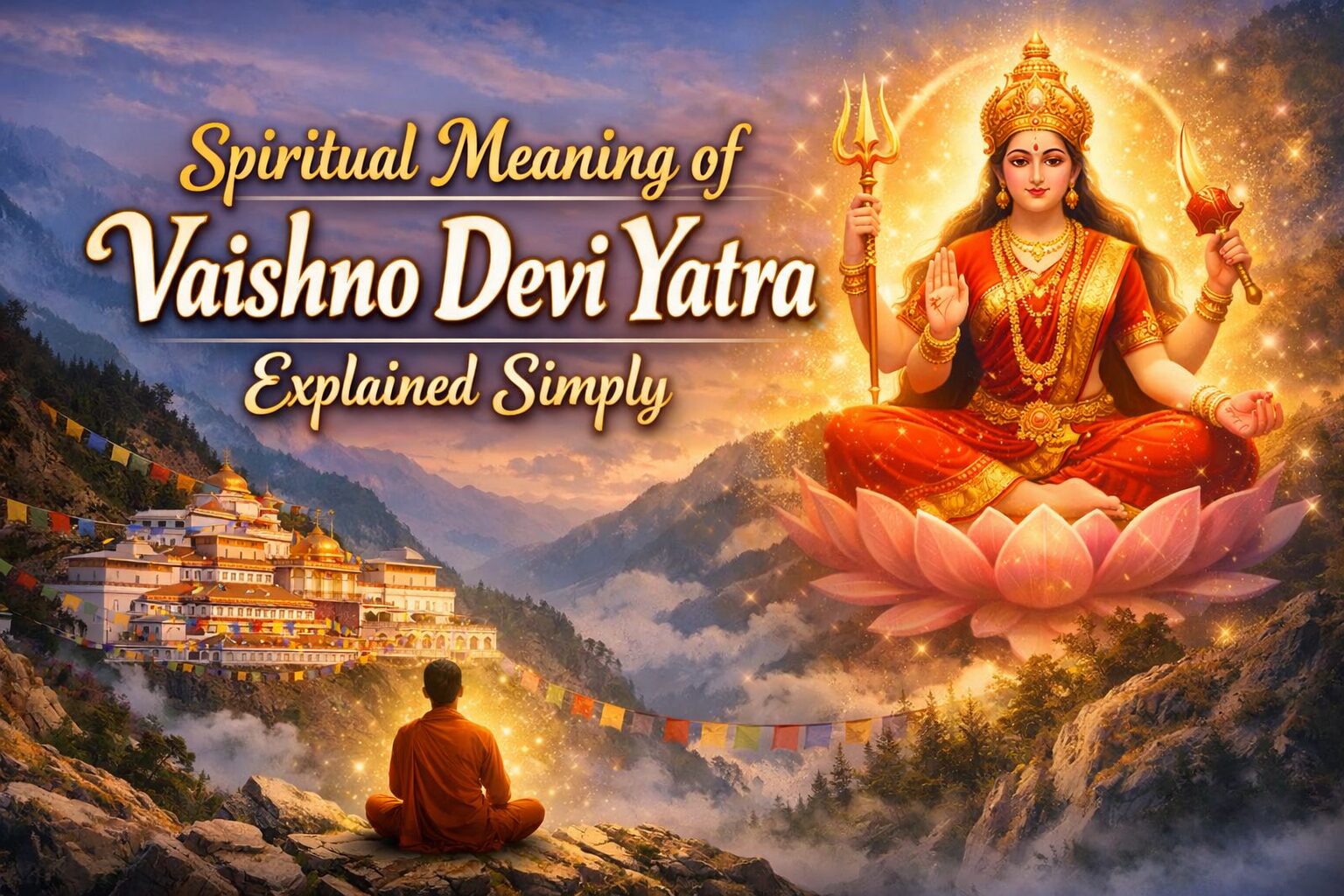

Spiritual Meaning of Vaishno Devi Yatra Explained Simply
Millions of people walk to Vaishno Devi every year. Some go with intense faith, some go because their family insists, and some go simply curious. But beyond crowds, prasad, and long queues, what is the spiritual meaning of the Vaishno Devi Yatra? This guide explains it in clear, simple language, whether you are deeply religious, somewhat spiritual, or just trying to understand what this journey really represents.
What Is the Vaishno Devi Yatra, Really?
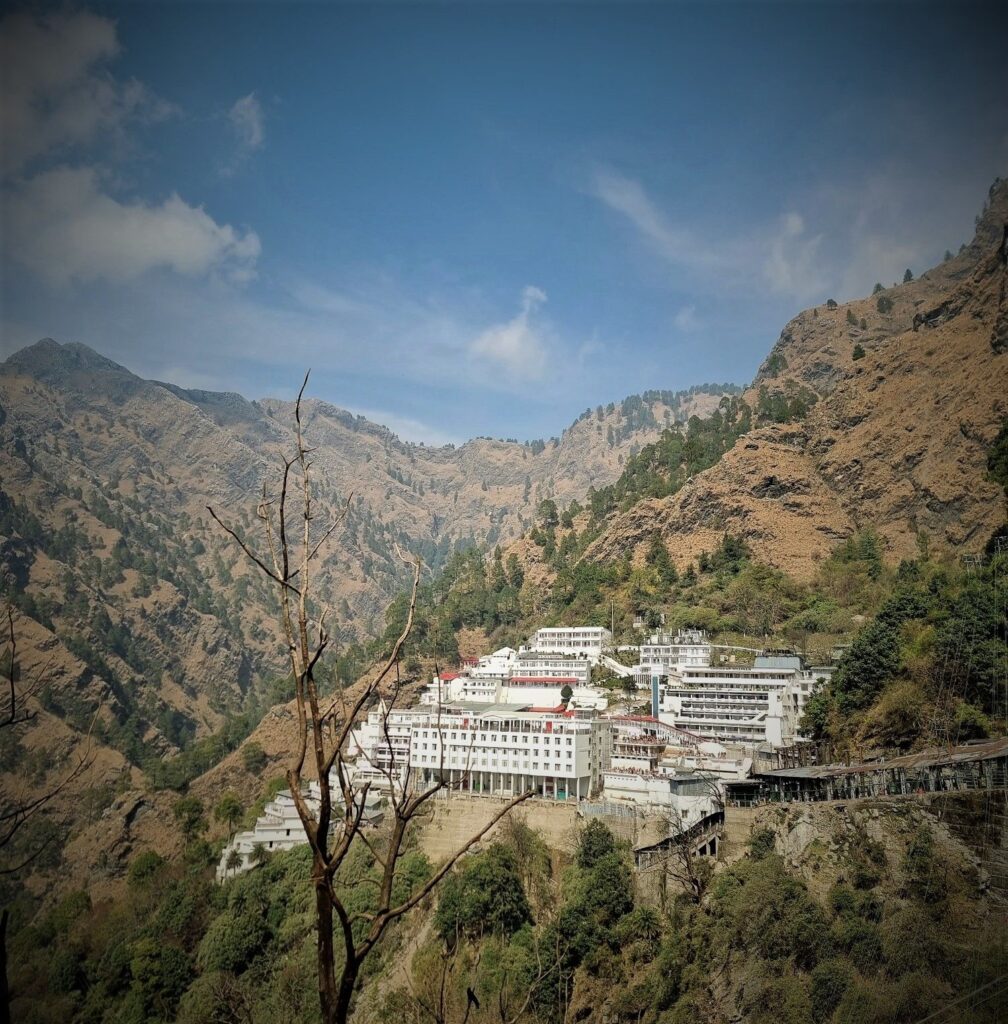
On the surface, the Vaishno Devi Yatra is a pilgrimage to the holy cave of Mata Vaishno Devi near Katra in Jammu & Kashmir. Devotees walk (or ride) about 12–14 km uphill from Katra to the Bhawan (main shrine), where the Goddess is worshipped in the form of three natural rock formations called the Pindis.
But spiritually, the Yatra is more than a physical journey. It is often described as:
- A journey from fear to faith
- A movement from ego to surrender
- A gradual shift from outer seeking to inner connection
In simple words: while your body climbs the mountain, your mind is invited to climb toward something higher within you.
Who Is Vaishno Devi? Simple Spiritual Understanding
Different traditions explain Vaishno Devi in slightly different ways, but most agree on this core idea: She is a manifestation of the Divine Mother, combining the powers of Maha Lakshmi, Maha Saraswati, and Maha Kali.
If this sounds abstract, here is an easy way to understand it:
- Lakshmi – represents abundance, support, nourishment, and stability (not just money, but emotional and spiritual support too).
- Saraswati – represents wisdom, clarity, right thinking, and inner guidance.
- Kali – represents protection, courage, and the power to destroy negativity and fear.
Vaishno Devi is believed to bring all three together. So when devotees say, “I am going to Mata’s darshan,” they are not only visiting a place; they are going to reconnect with protection, guidance, and inner strength in their own life.
Why Do People Feel Called to This Yatra?
Ask different people and you will hear similar reasons said in different ways:
- “Mann se bulawa aaya hai” – I feel a call from within.
- “I promised my Mother Goddess I would come if this problem was solved.”
- “I just feel like I have to go, even if I can’t fully explain why.”
Traditionally, it is believed that you can only go to Vaishno Devi when the Goddess calls you. In simple spiritual language, this can be seen as:
- A time when you are ready to let go of something old – pain, fear, guilt, or confusion.
- A moment when you are open to receive guidance, courage, or a fresh start.
- A silent readiness in your heart to sit with your own truth, even for a few moments.
So the “call” may not be a voice from the sky. It is often a quiet inner push: a mixture of longing, curiosity, and a wish that “something in my life should shift now.”
The Yatra as a Journey from Body to Soul
One of the simplest ways to understand the spiritual meaning of the Vaishno Devi Yatra is to see it as a layered journey:
- Body – your feet walk, your body tires, you feel heat, cold, sweat, pain.
- Mind – thoughts come up: doubt, hope, complaints, prayers, memories.
- Heart – slowly, something softens; you feel gratitude, emotion, maybe tears.
- Soul – for a few moments, you may feel deep silence, connection, or peace that words cannot fully describe.
You do not need to have visions, miracles, or dramatic experiences. Even a small shift—from worry to trust, from anger to acceptance—is spiritually meaningful. That is often what this Yatra gently encourages.
Symbolic Meaning of the Main Stages of the Yatra
Many devotees see each part of the journey as symbolizing something deeper. You do not have to believe this, but understanding it can make the Yatra feel more meaningful.
1. Katra – Saying “Yes” to the Journey
Katra is the base town, busy with shops, registration counters, hotels, and crowds. Spiritually, you can see Katra as representing your everyday life – busy, distracting, full of responsibilities.
When you start your Yatra from Katra, you are doing something simple but powerful: you are saying, “For a while, I am ready to move from routine to reflection.” Even if your reasons are mixed (fun, family, faith), you still take a step toward something sacred. That choice itself has spiritual value.
2. The Uphill Climb – Facing Your Inner Resistance
The path from Katra to Bhawan is a climb. It can be tiring, especially for those not used to walking. This physical effort mirrors your inner effort:
- Sometimes the climb feels easy – like days when life flows smoothly.
- Sometimes it feels endless – like phases of struggle, stress, or uncertainty.
Every time you feel like stopping and still choose to move a little further, you are quietly practicing:
- Perseverance – continuing even when it is not comfortable.
- Faith – trusting that the destination is worth the discomfort.
- Surrender – accepting your limits and asking for help when needed.
From a spiritual angle, this part of the Yatra teaches you: “I may not control every step, but I can choose not to give up.”
3. Ardhkuwari (Garbha Joon) – The Womb of Transformation
Ardhkuwari is an important stop on the way, known for the narrow cave called Garbha Joon. Tradition says Mata Vaishno Devi meditated here for nine months. Many see this as the womb (garbha) of spiritual transformation.
Symbolically, this represents:
- A space where the old you rests, and the new you begins to form.
- Moments in life when you feel stuck, hidden, or in darkness—but actually, you are being prepared for something new.
Standing or sitting in Ardhkuwari, many people silently bring to mind their fears, regrets, or deeply personal prayers. Even if you do not enter the narrow cave, just pausing here can be a way of saying: “I am willing to grow beyond my old patterns.”
4. Bhawan – Reaching the Inner Sanctuary
The Bhawan is the main shrine where the three sacred Pindis are located. For many, this is the emotional high point of the journey. You may have waited hours, been jostled in crowds, or traveled through the night. And then, for just a few seconds, you stand in front of the Goddess.
Spiritually, Bhawan can represent that brief but powerful moment when:
- Your mind goes quiet, even for a few seconds.
- You feel a deep sense of safety, as if someone is holding everything together for you.
- You realize that you can share your deepest truth without being judged.
Whether you call it God, energy, or simply an intense inner silence, this is the heart of the Yatra: a meeting between your limited self and something you perceive as limitless.
5. The Return Journey – Bringing the Blessing Back Home
Many people treat the return as just a downward walk. But spiritually, the descent is as important as the ascent. Going back to Katra symbolizes bringing the insights, calm, or strength you touched at the shrine back into your ordinary life.
In simple terms, the spiritual question is: “What will I take back from this Yatra, other than prasad and photos?” Maybe it is:
- A small habit of gratitude.
- A little more patience with your loved ones.
- A decision to handle one situation in your life with more courage and less fear.
The Three Pindis: What They Represent Spiritually
At the main cave, you do not see a statue but three natural rock formations, called Pindis. Devotees believe these are manifestations of the three forms of the Divine Mother.
In simple spiritual interpretation, they can represent three key forces inside you:
- Iccha Shakti (Power of Desire/Intention) – your genuine, heartfelt wish to grow, heal, or serve.
- Jnana Shakti (Power of Knowledge) – your clarity, understanding, and ability to see truth.
- Kriya Shakti (Power of Action) – your courage to act on what you know is right.
Spiritually, bowing to the Pindis can mean: “May my desires be pure, my understanding be clear, and my actions be aligned with what is right and compassionate.”
Common Experiences and Their Simple Spiritual Meaning
Not everyone has mystical visions. Most people have very ordinary human experiences that still carry a quiet spiritual meaning.
1. Physical Tiredness
The climb can be exhausting. Your legs hurt, you sweat, you may feel short of breath. Spiritually, this can remind you of your human limitations. It gently dissolves ego—the feeling that “I control everything.”
Many people find that in their tiredness, when they sincerely ask for strength, they discover a deeper layer of energy and resolve they did not know they had.
2. Emotional Release
Some people cry during the Yatra—sometimes without knowing exactly why. Tears can come at the sight of the shrine, during bhajans, or even while walking alone in the night.
Spiritually, this can be a release of stored emotions—grief, stress, shame, guilt, or long-held pain. In a safe environment where you feel protected, your heart gives itself permission to feel and let go.
3. Sense of Belonging
On the path, you see families, seniors, small children, rich and poor, all walking together. People share water, offer help, encourage strangers saying, “Jai Mata Di.”
Spiritually, this reminds you that beyond status, language, and background, we are all travelers—not just on this mountain, but in life.
4. Moments of Silence
Even with crowds, there are brief moments—the early morning chill, a quiet corner, a pause under the sky—where you suddenly feel calm.
These small pockets of silence are often where spiritual insight appears, not as words, but as a simple inner knowing like, “I am held. I am guided. I can handle what is coming.”
How to Approach the Yatra if You Are Not Very Religious
You do not have to follow every ritual or know every story to benefit spiritually from the Vaishno Devi Yatra. If you are more spiritual than religious, or even slightly skeptical, you can still treat it as a journey of self-reflection.
Here are some gentle ways to do that:
- Set a simple intention before starting: for example, “May this journey bring me clarity about my next step in life,” or “May I come back emotionally lighter.”
- Use the climb as moving meditation – walk with awareness of your breath, your steps, and your surroundings. When your mind wanders, gently bring it back.
- Observe your thoughts – frustration, jealousy, fear, hope – and simply notice them without judging yourself.
- Offer something inwardly – not money or gifts, but a negative habit, a grudge, or a fear you are finally ready to loosen.
Approached this way, the Yatra can support inner growth even if you do not see yourself as traditionally religious.
Simple Rituals and Their Inner Meaning
Many rituals at Vaishno Devi have a practical-spiritual double meaning. Understanding this can keep them from feeling mechanical.
1. Taking a Bath Before Darshan
Many devotees bathe before entering the Bhawan. On the surface, this is about physical cleanliness.
Spiritually, you can see it as an outer way of saying: “Let me wash off the dust of my worries, anger, and negativity, so I can come with a clean heart.”
2. Walking Barefoot or with Simple Footwear
Some people choose to walk in simpler footwear as a mark of humility.
Inner meaning: “I am willing to step out of my comfort and pride to experience something higher.”
3. Offering Coconut, Chunni, or Prasad
On the outside, these are standard temple offerings. On the inside, they can symbolize offering your ego, stubbornness, or fears to the Divine.
You can mentally say, “Along with this coconut, I place my worries and my attachment to controlling everything at your feet.”
4. Circumambulation (Parikrama)
Walking around the shrine is common in many temples. Symbolically, it means letting the Divine (or higher truth) be the center, not your own ego.
It can be a silent reminder: “My plans are not the center of the universe. There is a larger intelligence at work.”
Practical Aspects That Quietly Shape Your Inner Journey
Even practical choices affect your inner experience. A few considerations can help you stay more present and less stressed, which naturally deepens your spiritual connection.
Choosing How to Travel Up
Many people wonder if walking is “more spiritual” than going by pony, palki, or battery car. Spiritually, the main point is not to compare but to remain conscious and grateful in whatever mode you use.
- If you walk, use the time to reflect and chant.
- If you use a pony or car due to health or age, see that as surrendering to reality and accepting help—also a spiritual practice.
Dealing with Crowds and Discomfort
Crowds, waiting, and occasional pushing can test your patience. This is where everyday spirituality is actually practiced.
You can quietly work with small intentions like:
- “Today I will stand in this line without shouting or complaining.”
- “I will be kind to at least one stranger who seems more tired than me.”
These simple acts are often more spiritually powerful than long talks about religion.
Respecting Your Limits
Some devotees push too hard to prove their devotion physically. From a spiritual perspective, listening to your body is not a weakness—it is wisdom.
If needed, rest, hydrate, or choose easier options. You are not there to punish your body but to align body, mind, and heart with care and awareness.
Inner Transformations Many Devotees Report
Not everyone’s life changes dramatically after a Yatra, but many report gentle, lasting shifts. Some common ones include:
- Greater trust – A feeling that even in uncertainty, they are not entirely alone.
- Emotional healing – Letting go of an old hurt, forgiving someone, or forgiving themselves.
- Clarity of priorities – Realizing what truly matters and what is not worth constant anxiety.
- Renewed courage – A quiet strength to face health issues, financial strain, or family challenges.
- Increased gratitude – Simple appreciation for breath, family, support, and daily routines.
Even if problems do not vanish overnight, the inner way you relate to them can change. In many spiritual traditions, this shift in attitude is seen as one of the greatest blessings.
Is It Necessary to Believe in Miracles?
Stories of miracles—diseases cured, jobs found, crises resolved—are common in the context of Vaishno Devi. Some people relate deeply to these stories. Others feel unsure.
Spirituality here does not demand that you force yourself to believe everything. Instead, you can hold a balanced view:
- Stay open to grace without demanding proof.
- Acknowledge that sometimes, your own inner shift in courage and clarity leads you to take better decisions—which may appear as “miracles” from outside.
- Focus less on “Did a miracle happen?” and more on “Did my heart open? Did I grow in love, courage, or peace?”
Seen this way, the deepest miracle is often an inner change, not an outer event.
Making the Yatra Spiritually Meaningful for Children and Elders
If you are traveling with family, you can make the experience gently spiritual for everyone, without pressure.
For Children
- Explain Mata as a loving Mother who protects and blesses, not as someone to fear.
- Encourage them to think of one good habit they want to start and one unkind habit they want to drop.
- Involve them in small acts of kindness on the path—sharing snacks, giving space, saying thank you.
For Elders
- Give them time and space to sit quietly and pray in their own way.
- Help them conserve energy by choosing comfortable options so they can be mentally present rather than only physically exhausted.
- Listen to their stories of faith; treating their experience with respect is itself a spiritual practice.
Simple Ways to Continue the Yatra After Coming Home
The spiritual meaning of the Vaishno Devi Yatra does not have to end when the trip ends. You can keep a small part of it alive in your daily routine.
Some simple ways:
- Set aside 5 minutes daily to sit quietly, remember your time at the shrine, and reconnect with that feeling of peace or surrender.
- Practice one value you felt strongly during the Yatra—such as patience, kindness, or trust.
- Keep a small symbol from the Yatra (like prasad wrapping or a photo) in a place where you see it often, as a reminder of your inner promise.
- When life feels heavy, mentally imagine yourself climbing again, step by step, whispering “Jai Mata Di” or your own simple mantra, trusting that strength will come.
In this way, the mountain becomes a living memory within you, not just a location you once visited.
FAQ: Spiritual Meaning of Vaishno Devi Yatra
- 1. Do I have to be very religious to benefit from the Vaishno Devi Yatra?
- No. Even if you are only mildly religious or simply curious, the Yatra can still offer you time for reflection, emotional release, and inner clarity. Walking with sincerity and an open mind is more important than strict labels.
- 2. What is the main spiritual lesson of the Vaishno Devi Yatra?
- One central lesson is learning to move from fear and control toward trust and surrender. The journey teaches that while you cannot control everything in life, you can walk with faith, courage, and a softer heart.
- 3. Why do people say you can only go when Mata calls you?
- This is a devotional way of expressing that people often feel an inner push or perfect timing when they finally make the trip. Spiritually, it suggests that when you are ready for a certain kind of inner growth or healing, life arranges the outer circumstances.
- 4. Is walking all the way more spiritual than going by pony or battery car?
- Not necessarily. The deeper spirituality lies in your inner attitude—gratitude, humility, and sincerity—rather than how you physically travel. Choosing options that respect your health is also part of spiritual wisdom.
- 5. Why are there three Pindis, and what do they mean for a modern seeker?
- Traditionally, the three Pindis represent forms of the Divine Mother: Kali, Lakshmi, and Saraswati. For a modern seeker, they can also symbolize desire aligned with goodness, clear understanding, and right action—three forces that shape your life.
- 6. I did not feel anything special during darshan. Does that mean my Yatra was incomplete?
- No. Spiritual experiences are not always dramatic or emotional. Sometimes, the effect shows up quietly later—as more patience, strength, or clarity in daily life. What matters is the sincerity with which you walked, not what you felt in one moment.
- 7. Can the Yatra help with mental stress and emotional pain?
- While it is not a replacement for professional help when needed, the Yatra can offer emotional relief through prayer, tears, and a sense of being protected and heard. Many people return feeling lighter and more hopeful.
- 8. Is it okay to pray for personal wishes like a job, marriage, or health?
- Yes. In most traditions, it is natural to share your real needs with the Divine. You can also add a deeper prayer: “Give me wisdom and strength to accept and act well, whatever the outcome.” This balances desire with surrender.
- 9. What if I cannot visit due to health, money, or distance? Will I miss the blessing?
- Many teachers say that sincere remembrance and prayer from wherever you are can also connect you with the same Divine energy. The mountain is a powerful symbol, but your heart is the real temple. Intention and devotion matter more than physical distance.
- 10. How can I keep the spiritual feeling alive after returning home?
- You can revisit the Yatra in your mind for a few minutes daily, remember the peace or strength you felt, and try to live one value you touched there—like kindness, courage, or trust. In doing so, the Yatra continues inside you long after the trip.