

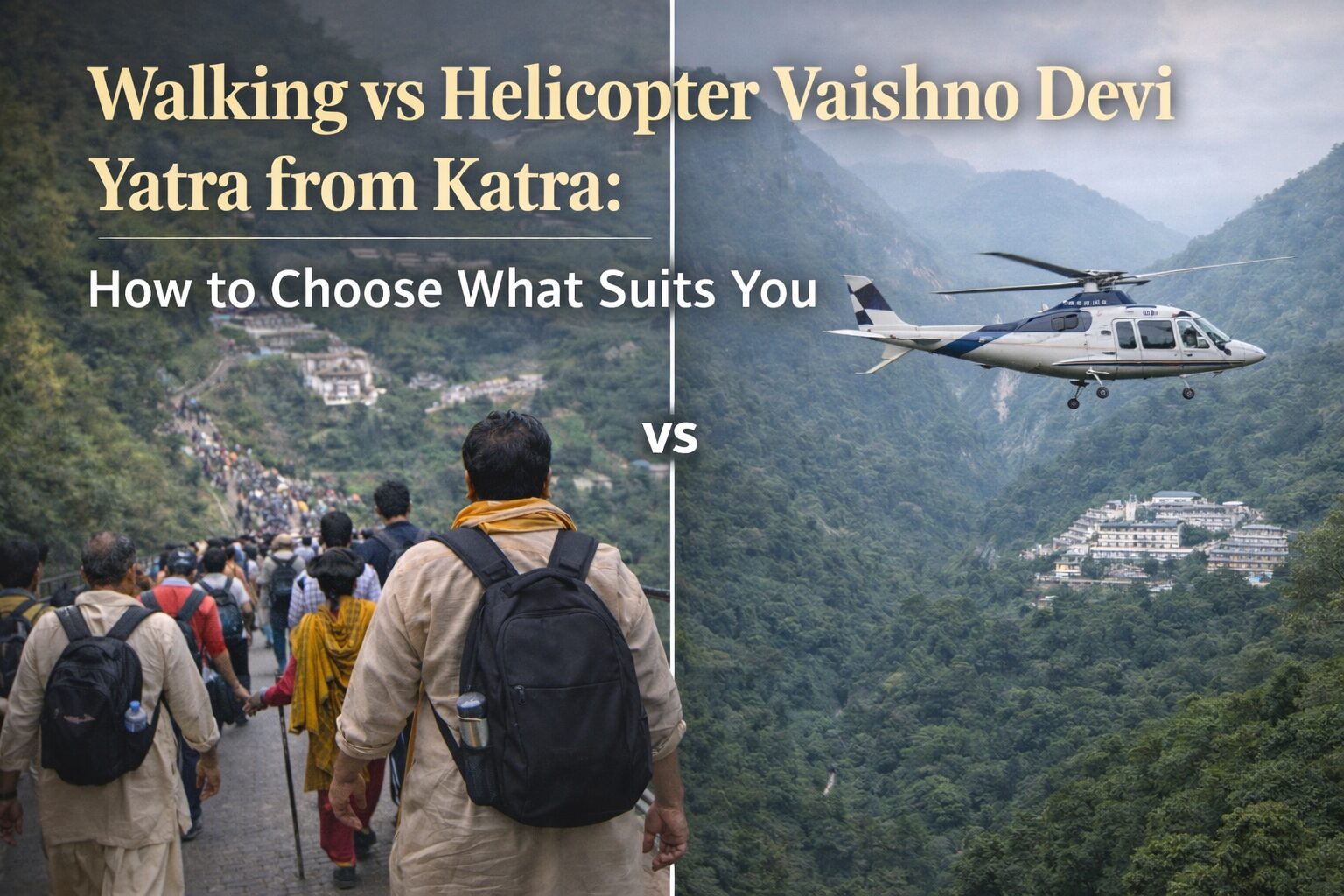

Walking or Helicopter for Vaishno Devi Yatra from Katra: How to Decide What’s Right for You

For most pilgrims arriving in Katra, one question tends to surface early: should you walk the Vaishno Devi Yatra or take the helicopter? It’s a practical choice, but also an emotional one, because how you travel shapes how the journey feels from start to finish.
The traditional walking route and the helicopter option both exist to serve different needs. Walking offers time, rhythm, and gradual immersion. Helicopter travel offers physical relief and time efficiency. Neither option is inherently better, and neither suits everyone equally.
What matters is understanding what each option actually involves on the ground—how it affects your body, your schedule, and your experience of the pilgrimage. This guide breaks down the decision in plain terms, focusing on real-world conditions rather than opinions or ideals, so you can choose calmly and realistically.
Why This Choice Matters on the Vaishno Devi Yatra
The shrine of Mata Vaishno Devi is located high in the Trikuta Mountains, and reaching it requires effort no matter how you travel. The difference lies in where that effort is spent—on the walking track, or in waiting, coordination, and weather dependence.
Walking the yatra has long been part of the pilgrimage tradition. It unfolds slowly, giving pilgrims time to adjust physically and mentally. Helicopter travel, introduced to improve accessibility, shortens the physical journey but adds its own set of conditions, including fixed schedules and weather sensitivity.
Many first-time visitors underestimate how much this choice affects pacing, fatigue, and overall stress levels. Understanding the implications early helps avoid regret later, especially for families, senior citizens, and those on tight schedules.
How Most Pilgrims Tend to Make This Decision
Most pilgrims don’t arrive in Katra with a fully settled plan. Many assume they’ll decide after seeing the route or assessing their energy levels. While this flexibility can work, it often leads to confusion during busy periods.
Younger or physically active pilgrims usually lean toward walking, often seeing it as an integral part of the experience. Families and senior travelers are more cautious, weighing comfort and safety more heavily than tradition. Some pilgrims plan to walk one way and consider the helicopter for the return, hoping to balance effort and recovery.
What experienced travelers often learn is that decisions based on physical ability and time constraints tend to work better than decisions based on what feels expected or symbolic.
What Walking the Vaishno Devi Yatra Actually Involves
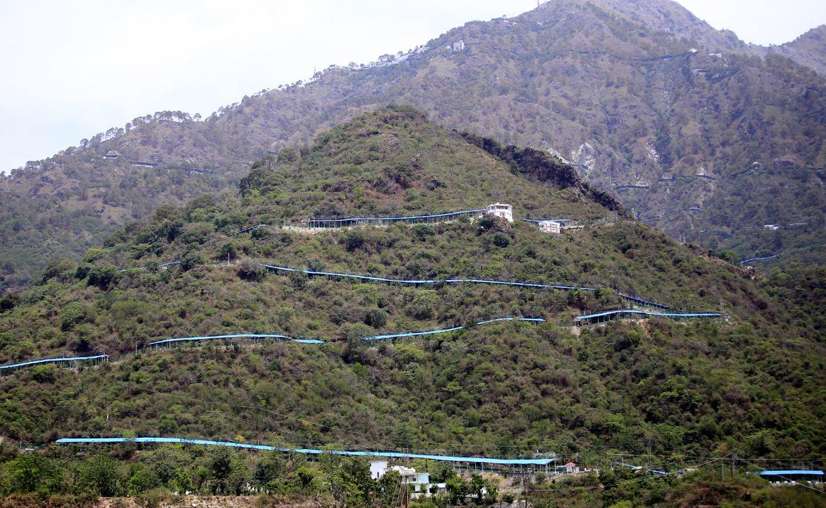
Walking from Katra to the Vaishno Devi Shrine is a long, continuous uphill journey on a paved, well-maintained path. There are no technical challenges, but endurance plays a major role.
Pilgrims typically spend several hours walking, with additional time spent resting, queuing, and moving slowly through crowded sections. The ability to stop frequently is a major advantage of walking. You control your pace, take breaks when needed, and respond to how your body feels.
Many pilgrims find walking mentally grounding, as the gradual climb creates a sense of progression. At the same time, fatigue builds steadily, and the return journey—though downhill—can strain knees and joints.
Walking works best for those with reasonable stamina, flexible schedules, and comfort with prolonged physical activity.
What Helicopter Travel Looks Like in Practice
Helicopter travel significantly reduces physical effort but does not remove the need for patience. Flights operate between Katra and Sanjichhat, after which pilgrims still walk a short distance to the shrine.
The biggest advantage is conserving energy, which can be critical for senior citizens or those with joint or health concerns. It also suits travelers who have limited time available.
However, helicopter travel comes with constraints. Flights are highly weather-dependent, and delays or cancellations are common. Waiting times, security checks, and coordination can take longer than expected, especially during peak seasons.
Emotionally, helicopter travel can feel efficient and relieving for some, while others feel slightly disconnected from the gradual journey. These reactions vary widely and are shaped by expectations rather than the mode itself.
Walking vs Helicopter: A Side-by-Side Reality Check
| Aspect | Walking the Yatra | Helicopter Travel |
|---|---|---|
| Physical effort | High | Low to moderate |
| Time flexibility | High | Limited |
| Dependence on weather | Moderate | High |
| Pace control | Full control | Fixed |
| Overall experience | Gradual, immersive | Compressed, practical |
This comparison is not about choosing a “better” option. It highlights trade-offs. Walking demands time and stamina. Helicopter travel demands flexibility and patience with uncertainty.
What Tends to Work Best for Different Travelers
| Traveler Type | Usually More Comfortable With |
|---|---|
| First-time solo pilgrims | Walking |
| Families with children | Mixed approach |
| Senior citizens | Helicopter |
| Tight itineraries | Helicopter |
| Physically active groups | Walking |
Families often benefit from mixing options, especially if energy levels vary widely within the group. Senior citizens generally report a smoother experience when physical strain is minimized. Active travelers often value the control and pacing that walking provides.
The key is matching the option to the most vulnerable member of your group.
How Season and Timing Influence the Decision
Seasonal conditions affect both walking and helicopter travel, but in different ways.
| Condition | Walking Impact | Helicopter Impact |
|---|---|---|
| Summer heat | High fatigue | Less physical strain |
| Monsoon rain | Slippery paths | Frequent cancellations |
| Winter cold | Joint stiffness | Weather delays |
| Peak crowds | Slow progress | Long waits |
Walking becomes harder in heat and rain, while helicopter reliability drops sharply in poor weather. Timing within the day also matters—early mornings reduce heat for walkers, while helicopter operations run only during specific windows.
Choosing based on season often matters more than choosing based on preference alone.
Common Misunderstandings About These Options
A common belief is that helicopter travel is an easy shortcut. In reality, it replaces physical effort with waiting, scheduling, and weather uncertainty.
Another misconception is that walking is only for the young or fit. Many average-health pilgrims complete the walk successfully by pacing themselves and resting often.
Some feel that walking is spiritually superior. This belief varies by individual and is not reflected in how pilgrims are treated at the shrine. Both options are equally valid.
How First-Time Visitors Can Decide Calmly
If this is your first Vaishno Devi Yatra, start with practical questions. How long can you walk comfortably? Do your knees handle downhill movement well? How much time do you realistically have?
If walking feels uncertain, choosing the helicopter is sensible. If walking feels manageable, allow extra time and avoid rushing. Mixing options is acceptable if flexibility allows.
The aim is not to test endurance or efficiency, but to arrive safely, calmly, and without unnecessary strain.
Frequently Asked Questions
Is walking better than taking the helicopter?
Neither is better for everyone. The right choice depends on health, time, and comfort.
Do senior citizens need to take the helicopter?
Not always, but many find it reduces strain and fatigue significantly.
Does helicopter travel eliminate walking completely?
No. There is still a short walk after landing.
Is helicopter travel reliable year-round?
No. It is highly dependent on weather conditions.
Can families combine walking and helicopter options?
Yes, though it requires flexibility and patience.
Does walking make the yatra more meaningful?
Meaning is personal. Both options are equally valid.
Closing Thoughts
Walking and helicopter travel represent two different ways of approaching the same sacred journey. One emphasizes time, endurance, and gradual progress. The other emphasizes accessibility and conservation of energy. Neither defines devotion, and neither guarantees a better experience on its own. When the choice is made honestly—based on physical comfort, season, and schedule—the Vaishno Devi Yatra tends to feel steadier and more fulfilling. Thoughtful decisions allow the focus to remain on the purpose of the journey rather than the strain of reaching it.